AI Sales Agents vs CRM, Sales Intelligence and Automation — bizTOnetBack to blogArticleB2B Growth
AI Sales Agents vs CRM, Sales Intelligence and Automation
Compare AI Sales Agents with CRMs, sales intelligence platforms, automation tools, social networks and B2B marketplaces.
By bizTOnet TeamAugust 24, 20264 min read 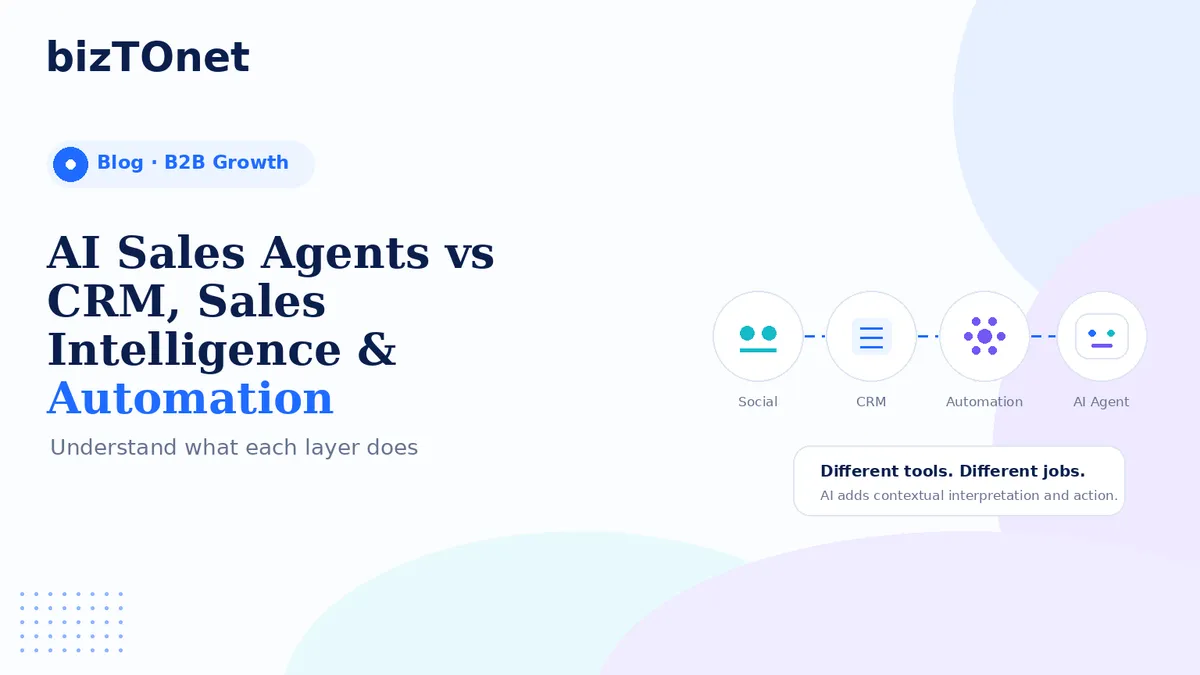
B2B companies already use many technologies for sales.
So what exactly does an AI Agent add?
The answer becomes clearer when you distinguish the purpose of each category.
Social networks
Primary function:
Relationships + Visibility
They help professionals:
connect;
publish;
communicate;
build audiences.
The limitation is business intent.
A connection does not automatically indicate a need.
Primary function:
Company and contact data
They help teams identify:
accounts;
decision-makers;
firmographics;
contact information;
external signals.
They answer:
They do not necessarily answer:
Who actually needs us now?
CRMs
Lead and pipeline organization
accounts;
contacts;
Opportunities;
stages;
activities;
forecasts.
What business are we currently tracking?
A CRM typically relies on people or other systems to create and update the underlying commercial information.
Repeat predefined actions
When Lead enters stage X, send email Y.
Automation is powerful when the logic is predictable.
It is weaker when action depends on nuanced context.
B2B marketplaces
Connect supply and demand
They make Products, Services or requirements visible.
They are particularly useful when buyer intent is explicit.
AI Agents
Interpret context and help determine or execute actions
This makes it conceptually different from a database or workflow engine.
Comparison
Tool | Main job |
|---|
Social network | Relationships and visibility |
Sales intelligence | Prospect information |
CRM | Lead and pipeline organization |
Automation | Rule-based execution |
Marketplace | Supply and demand |
AI Agent | Contextual interpretation and action |
The categories can complement one another.
Example
Suppose a company is looking for a cybersecurity consultant.
Marketplace
CRM / Lead system
Tracks the commercial interaction.
Social network
Provides relationship context.
AI Agent
the need matches your Service;
timing is immediate;
your colleague already knows the decision-maker;
a similar Lead converted recently.
The Agent then helps prioritize the business.
Why AI Agents need context
Without context, an Agent becomes a generic assistant.
With context, it can reason about commercial relevance.
Offers;
Opportunities;
relationships;
interactions;
conversations;
Lead history;
timing.
The future of Agentic sales is therefore not just better language models.
It is better business context.
Does the AI Agent replace the CRM?
A Lead-management system organizes business.
An Agent helps interpret and work it.
Similarly, the Agent does not replace:
Marketplace;
professional network;
Offer;
salesperson.
It adds intelligence across them.
What about bizTOnet?
The distinction is particularly important here.
bizTOnet is not an AI sales Agent.
bizTOnet is a social network to do business that combines:
business networking;
Company Pages;
Marketplace;
Products and Services;
Opportunities;
Leads;
conversations.
The AI Agent is one capability available inside this environment.
It helps members work the business context created by those other components.
FAQ
Is ChatGPT an AI Agent?
A conversational AI can be part of an Agentic system, but an Agent usually also involves goals, context and the ability to take or recommend actions.
Are AI Agents just automation?
No. Automation executes predefined rules. Agentic systems can evaluate context before choosing an action.
Will CRM disappear?
It may evolve, but businesses will still need structured information about commercial relationships.
Are AI Agents useful for small businesses?
Potentially yes, particularly because small teams have limited sales resources.
Think in layers
Which one tool should replace everything?
What layer does each system solve?
The strongest B2B stack may combine:
Network + Marketplace + Lead Management + AI
Each solves a different part of the commercial problem.
