social network to do business
The social network where business leaders connect, interact and do business.
© 2026 bizTOnet. All rights reserved.
contact@biztonet.com
How to Build a Client Acquisition System Beyond Referrals — bizTOnet
Article Find-clients
How to Build a Client Acquisition System Beyond Referrals Build a more predictable client acquisition system using relationships, outreach, content, business intent and structured Lead management.
By bizTOnet Team In this article
How to Build a Client Acquisition System That Does Not Depend on Referrals Referrals are one of the best ways to acquire B2B clients.
They transfer trust before the first conversation, often improve conversion and reduce acquisition costs.
They also have one major weakness:
You cannot control them.
A company that depends entirely on referrals cannot reliably decide:
how many Leads will arrive next month;
which market they will come from;
whether they fit the target;
whether the projects will be profitable.
The goal is not to eliminate referrals.
It is to build a broader acquisition system around them.
The five foundations A repeatable client acquisition system needs:
Target
Offer
Lead sources
Conversion process
Measurement
AI can then add an intelligence layer across these components.
1. Define your target Specify the market you want to reach.
Possible dimensions:
industry;
company size;
geography;
business model;
maturity;
decision-maker;
triggering situation.
The best target is often defined partly by a situation.
Growing B2B companies building their first structured sales organization.
This may be more commercially useful than:
2. Create an Offer connected to a trigger Companies rarely wake up wanting to buy consulting.
expansion;
growth;
regulation;
operational breakdown;
product launch;
hiring;
technology replacement;
acquisition.
Attach the Offer to this moment.
Market-entry program for B2B companies preparing to launch in France.
The trigger improves acquisition relevance.
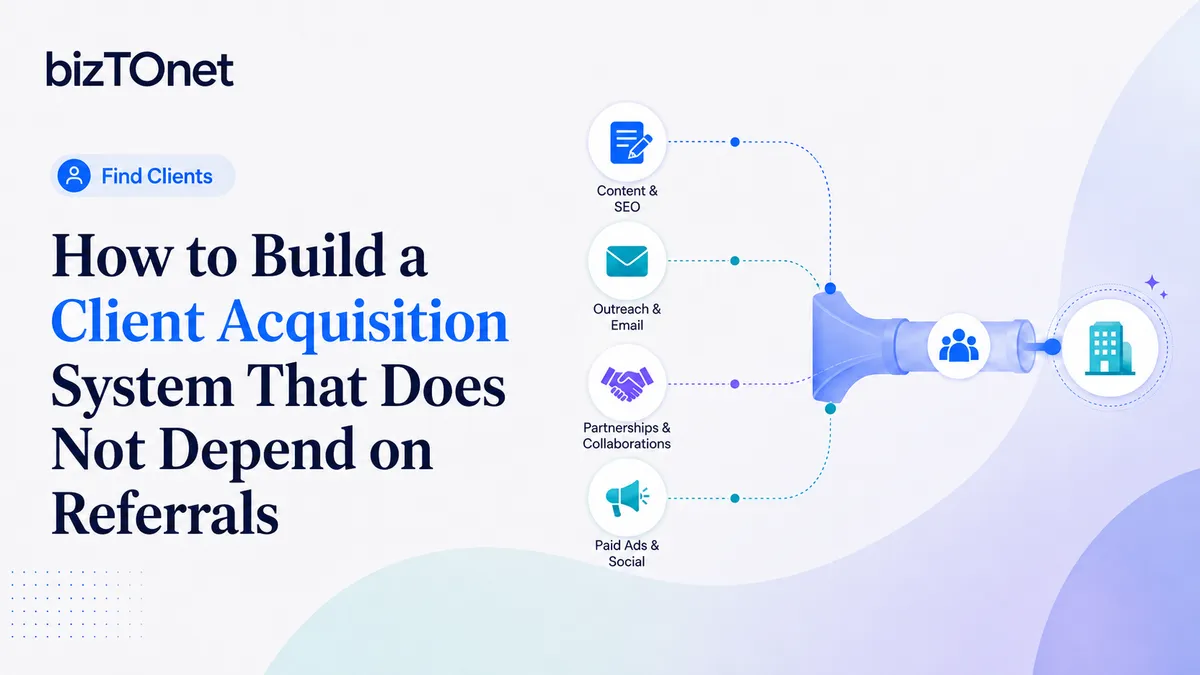
3. Build a diversified channel mix A useful model contains four categories.
Relationship-driven referrals;
existing clients;
partners;
personal network.
Outbound email;
telephone;
social outreach;
account-based campaigns.
Low intent when targeting is poor.
Inbound SEO;
articles;
research;
webinars;
social content.
Scalable and compounding.
Intent-based business Opportunities;
procurement requests;
Marketplace demand;
partnership searches.
Clearer evidence of need.
Availability varies by market.
The strongest systems combine categories.
4. Define what a qualified Lead means Do not call every contact a Lead.
And do not call every Lead qualified.
A qualified Lead should demonstrate sufficient evidence across several dimensions.
Fit × Intent × Timing × Relationship
Fit Does the company match your Offer?
Intent Is there evidence of a real need?
Timing Is there a reason to act?
Relationship What connection already exists?
The framework prevents commercial teams from treating every interaction equally.
5. Build a consistent pipeline Simple stages are enough.
Identified
Contacted
Conversation
Qualified
Proposal
Decision
Won / Lost
Define the exit criteria for every stage.
For instance, a Lead should not enter “Qualified” simply because someone accepted a meeting.
6. Build follow-up into the process Good acquisition is not only about starting conversations.
It is also about maintaining them.
The follow-up should create decision progress.
7. Add an intelligence layer with AI AI should not necessarily be viewed as a fifth acquisition channel.
It is more useful as a layer working across existing channels.
Channels create signals → AI helps interpret signals → Humans manage relationships and decisions
AI is most valuable when the underlying context is good.
If your target, Offer and Lead data are poor, AI simply processes poor information faster.
8. Measure the complete system Track each acquisition source.
Leads generated;
qualified Leads;
meetings;
proposals;
win rate;
contract value;
cycle length;
revenue;
acquisition cost.
Do not optimize only for response rate.
A channel generating 20 responses and no clients may be weaker than a channel generating three conversations and two deals.
Example acquisition system Imagine an independent cybersecurity consultant.
Relationship Ask former clients and IT partners for introductions.
Outbound Contact companies that recently achieved relevant compliance milestones or expanded infrastructure.
Inbound
Intent Respond to companies actively looking for security assessments.
AI layer Analyze incoming Opportunities and Lead activity to identify priority conversations.
Now acquisition no longer depends on one source.
Frequently asked questions
Are referrals still worth prioritizing? Yes. The goal is diversification, not replacement.
How many channels should I operate? Enough to reduce dependency, but not so many that none receives consistent attention. Two to four active channels are often easier to manage than ten.
Is outbound still effective? Yes when targeting and context are strong. Generic mass outreach performs poorly and can damage reputation.
Does AI replace prospecting? No. It can reduce research, qualification and workflow effort, but companies still need ways to generate business signals and human relationships.
Build an acquisition system you can control Referrals only → Multiple demand sources → Structured Leads → Continuous qualification → Repeatable growth
bizTOnet reflects this model by combining a social business network, Marketplace, Opportunities, Leads, conversations and an AI Agent available to help members interpret and work relevant business signals.