What Is B2B Business Intent? Fit, Intent, Timing & Relationship
Learn what B2B business intent means and how Fit, Intent, Timing and Relationship can reveal stronger buying potential.
By bizTOnet TeamAugust 24, 20264 min read
What Is B2B Business Intent?
Business intent is evidence that a company has a current or emerging need related to a Product, Service or business relationship.
It is one of the most important differences between:
A company that could theoretically become a client
and:
A company showing signs that a commercial conversation may actually be relevant.
Intent does not guarantee a purchase.
It makes the possibility more meaningful.
Fit and intent are not the same
Consider a perfect target company.
It has:
the right industry;
right size;
right geography;
right budget.
That is Fit.
But perhaps it is perfectly happy with its current provider and has no project.
Intent is low.
Now imagine another company with slightly weaker Fit.
It publishes:
We need a new cybersecurity provider within the next six weeks.
Intent is high.
Which deserves attention?
Probably the second.
More articles
Types of business-intent signals
Signals vary in strength.
Passive signals
profile visit;
social engagement;
content reading.
These may indicate interest.
They do not necessarily indicate a buying project.
Active exploratory signals
repeated Offer visits;
detailed questions;
direct message;
solution comparison.
Intent is stronger.
Explicit signals
published Opportunity;
request for pricing;
request for proposal;
project discussion.
These indicate a more visible need.
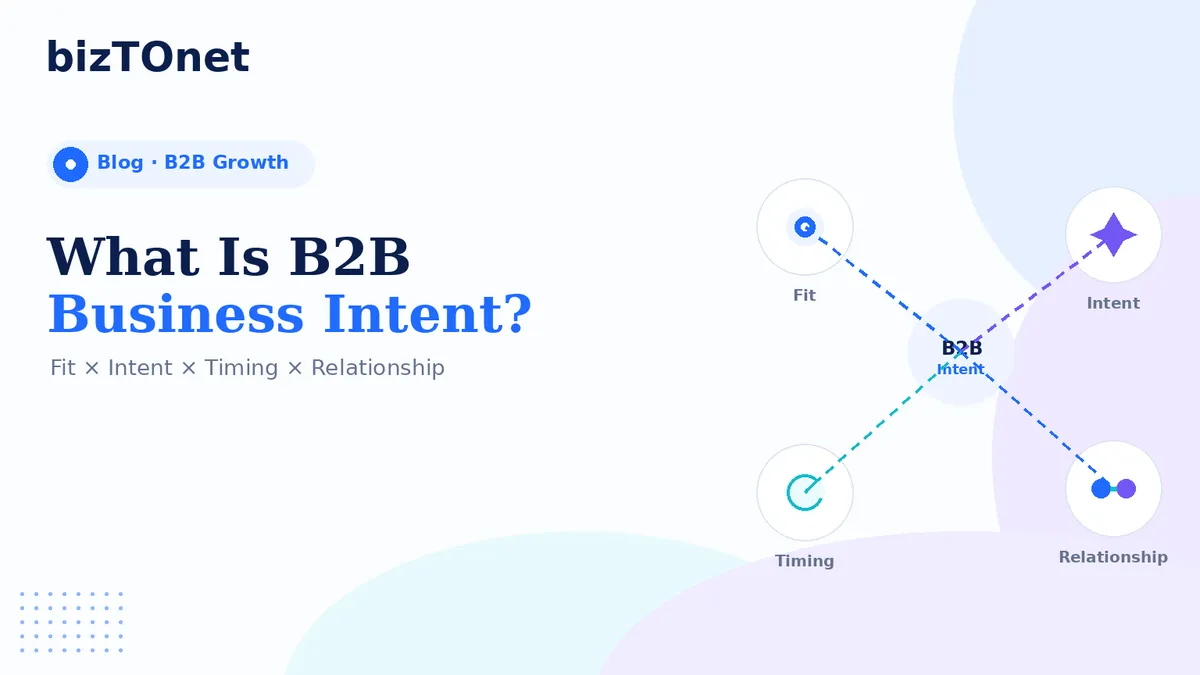
Fit × Intent × Timing × Relationship
Intent becomes more useful when combined with three other dimensions.
Fit
Are you relevant to each other?
Intent
Is there evidence of a need?
Timing
Why might action happen now?
Relationship
What connection already exists?
This produces a richer view of commercial potential.
Timing
A company may need your Service but have no urgency.
Timing signals include:
project deadline;
regulation;
expansion;
new budget;
technology renewal;
leadership change.
Timing helps prioritize.
Relationship
Business is relational.
Two otherwise identical prospects may have different commercial potential because:
one is completely cold;
another was introduced by a trusted client.
Relationship can affect:
trust;
access;
conversion speed;
information quality.
Examples
Company A
Fit: High Intent: Low Timing: Unknown Relationship: Strong
Potential:
Maintain relationship, but no immediate sales push.
Company B
Fit: High Intent: High Timing: High Relationship: Medium
Potential:
Priority Lead.
Company C
Fit: Low Intent: High Timing: High Relationship: Strong
Potential:
The need is real, but you may not be the right provider. Consider referral.
This is why one-dimensional lead scoring is often insufficient.
Explicit intent is especially valuable
One of the clearest intent signals is a company saying directly:
We are looking for X.
A business Opportunity makes demand explicit.
Instead of inferring from behavior, the business states the need.
This gives providers stronger context.
It also gives AI systems more meaningful information for matching.
How AI can help interpret intent
At scale, signals become difficult to monitor.
An AI Agent may evaluate:
Opportunities;
Offer interactions;
conversations;
relationships;
Lead progression.
It can help identify patterns humans might not immediately notice.
However:
AI should not convert probabilistic signals into false certainty.
A profile visit does not mean:
This company wants to buy.
Commercial interpretation should remain grounded.
How to use business intent in sales
Prioritize
Give stronger signals more attention.
Personalize
Use real context in outreach.
Qualify
Ask questions connected to the apparent need.
Time follow-up
Act when business context indicates relevance.
Disqualify
Stop pursuing weak signals indefinitely.
FAQ
Is website traffic a buying signal?
Potentially, but often weak unless behavior is highly specific and repeatable.
Is an Opportunity stronger than website activity?
Usually yes because the need is explicitly stated.
Can intent disappear?
Absolutely. Projects are canceled, budgets change and priorities move.
Can AI predict intent?
AI can estimate relevance from signals, but prediction should not be confused with certainty.
Business intent makes B2B activity more actionable
The difference between generic prospecting and intent-driven business development is simple:
Generic prospecting asks who might need us.
Intent-driven business development looks for evidence of who may need us now.
Combining:
Fit × Intent × Timing × Relationship
helps make that judgment more complete.
On bizTOnet, Products and Services show what companies sell, Opportunities reveal explicit demand, relationships and conversations add context, Leads organize potential business, and the AI Agent available on the network helps members continuously work those signals.